
25 Years of KMPF: A reflection on partnership and purpose
By Joni Chase

What do you want to be when you grow up? It is a question most young people hear repeatedly throughout their education, often long before they have the knowledge, certainty or confidence to answer.
Like many, I was never sure, but I knew I cared about social inequality and believed in the transformational power of education. I didn’t grow up knowing what widening participation was, mainly because it didn’t really exist in its current form as a sector. But, by chance, I fell into the field over 20 years ago, and it is one I can’t imagine ever leaving. Why? Because the work matters.
“Widening participation” emerged as a policy concept in the 1990s, driven by growing recognition that access to higher education (HE) was unequal and required systemic intervention. This was strengthened in the early 2000s through national targets to increase HE participation and address regional disparities. It was within this evolving policy landscape that I entered the sector in 2004 and, for much of my career, the Kent and Medway Progression Federation (KMPF) has been my professional home.
KMPF is a partnership of universities, schools, colleges, and local organisations that work together to support young people, particularly those from underrepresented backgrounds, to access higher education (HE). Through targeted outreach, KMPF helps learners build confidence, remove barriers, develop skills and make informed choices about their futures. This year marks 25 years of KMPF, a significant milestone in a sector defined by constant change.
From Aimhigher to KMPF: choosing to continue
The widening participation landscape has always been shaped by shifting national priorities, funding cycles and policy reforms. Programmes evolve, structures change, and with them, continuity for the very learners who need it most.
The national Aimhigher programme was designed to ‘raise aspirations’ and increase participation in higher education. It emphasised collaboration, outreach, and early evidence of learner tracking. Thanks to a change in government, when national funding ended in 2011, many regional partnerships across the country dissolved. In Kent and Medway, however, partners recognised both the value of collaboration and the continued need for a coordinated, impartial outreach structure. Rather than disbanding, Aimhigher Kent and Medway evolved into the Kent and Medway Progression Federation (KMPF). This was not simply a rebrand; it was a decision to sustain collective working beyond national funding boundaries.
What we’ve built together
KMPF’s development has been shaped by continuity of leadership, shared purpose, and collaboration across sectors. A key feature of this has been its commitment to evidence-based practice, including learner tracking systems such as the Higher Education Access Tracker (HEAT), which now enables over 100 members to to track and evaluate the impact of widening participation activities designed to enable progression. HEAT allows members to evaluate which programmes actually improve access and outcomes
There are countless activities that form part of KMPF’s everyday work, such as campus visits, masterclasses, mentoring, ambassador programmes, and sustained outreach across key transition points. However, the true impact lies not in standalone interventions, but in how they combine to create long-term change for young people.
One significant example is the development of the Care Leaver Progression Partnership (CLPP). Initially focused on improving support for care-experienced learners, it evolved into a multi-agency collaboration committed to identifying and removing barriers to post-16 progression. It represented a shift from targeted activity to sustained, system-level partnership working.
Another more recent development is the shared regional commitment to care experienced progression embedded within the Access and Participation Plans (APPs) of three higher education providers in Kent. Rather than working in isolation, institutions have aligned priorities, shared evidence, and coordinated their activity. Led by KMPF, this collaboration is now reflected in the joint delivery of the Opening Doors programme, with outreach work aimed at care-experienced learners delivered collectively across the region.
A community of practitioners
What truly defines KMPF is not its structure, but its people.
The core team work alongside colleagues across partner organisations who are deeply committed to their learners and to addressing inequality across Kent and Medway. This is a community of practitioners who understand that widening participation is not a single intervention, but sustained and progressive work.
There is a shared understanding across the partnership that inequalities in access to higher education remain persistent and, in many cases, increasingly complex. Financial pressures, attainment gaps, structural barriers (including a selective education system in Kent), and uneven regional opportunity all continue to shape learner outcomes and destinations.
In this context, collaboration is not optional; it is a necessity.
Policy changes and future direction
Recent policy developments reinforce the importance of this collective approach. The initial introduction of Access and Participation Plans (APPs) from 2018 placed greater responsibility on universities to address inequalities in access, success, and progression regionally. The newest direction of travel for policy sees an emerging approach, encouraged by the Office for Students (OfS), where multiple institutions work together to address shared regional inequalities. Uni Connect guidance echoes the expectation that the future for collaborative outreach and widening participation activity should be collaborative, evidence-led, and locally coordinated.
Regional partnerships are therefore fast becoming a central feature of the current landscape. Across further and higher education, there is a growing expectation that providers work together more intentionally at a place-based level, sharing intelligence, aligning provision, and co-designing pathways that support learners from outreach through to progression. This shift reflects a recognition that no single institution can address widening participation challenges in isolation, and that sustained impact depends on strong, structured collaboration across regions.
At the same time, inspection reforms such as those led by Ofsted have shifted towards a broader understanding of educational quality, focusing more on inclusion and learner experience. These shifts closely reflect the principles that widening participation has long been built upon. The recent Post-16 Education and Skills White Paper reinforced the importance of local skills alignment, clearer progression routes, and stronger employer engagement within post-16 education. It sets out a vision for a more employer-led, locally responsive skills system, with greater emphasis on technical pathways, progression routes, and lifelong learning.
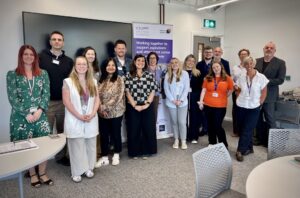
These priorities already align closely with the work of KMPF, and it increasingly feels that we are ahead of the curve. Recently, KMPF hosted a Further Education (FE) strategy day focused on strengthening regional partnerships and identifying new opportunities to address our local challenges. Solidified by the voices of student Ambassadors, attendees heard how (Uni Connect-funded) outreach had enabled one Ambassador to identify not ‘what I wanted to do’ but ‘who I wanted to be’.
Looking ahead: why this work matters
KMPF has shown that partnership working can endure beyond policy cycles and funding changes and that when institutions choose to work together, they can create something greater than the sum of their parts.
But this is not just a story of longevity, it’s a case for what the sector should prioritise next. Our work is not about participation rates in isolation or compliance with regulatory frameworks. It is about whether young people can see a future for themselves and whether the system around them makes that future feel possible.
The role of partnerships like KMPF is to make that possibility real: to give young people the space, support, and confidence to work out who they want to be, and to ensure that higher education is a clear, accessible route to getting there.
If the direction of policy is towards collaboration, place-based working, and shared responsibility, then the lesson from 25 years of KMPF is simple: this approach works. The challenge now is not whether to collaborate, but how seriously the sector is willing to commit to it.
Joni Chase is Widening Participation (WP) Partnerships and Programme Development Manager at the University of Kent.